
Grant County Probate Records Overview
Grant County does not have a separately named surrogate court or orphans' court. Probate is handled inside the Circuit and Superior Courts, and the State Court Structure Map names it the Probate Division of the Circuit/Superior Court system. Local rules assign all ES, EU, and EM estate cases to Grant Superior Court 1. GU guardianship cases involving incapacitated adults and minors also go to Superior Court 1. The Clerk of the Circuit Court keeps a record of wills and matters of trust in probate proceedings, accepts filings, issues process, enters judgments and orders, and maintains records.
Grant County probate records can include petitions to open estates, wills, inventories, bonds, letters, notices, creditor claims, accountings, closing statements, guardianship petitions, physician reports, guardian instructions, biennial reports, and court orders. Many probate orders are public, but the research flags medical evidence, minor information, financial account identifiers, and protected-person details as access-limited under Indiana court-record rules.
The Grant County Family Recovery Court source is one successful probate-records image in the manifest.
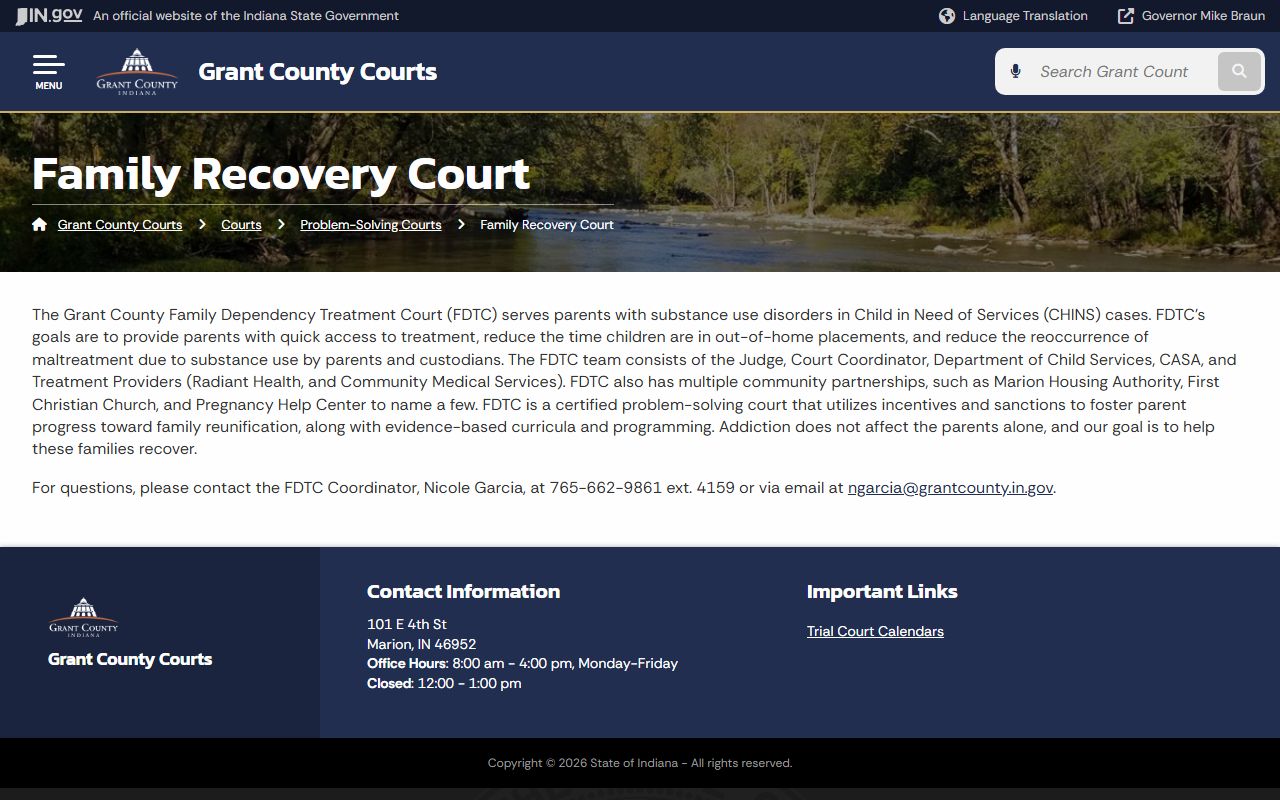
Although Family Recovery Court is not the probate docket, it reflects the same local Superior Court structure that routes family, guardianship, and protected-person issues through assigned Grant County courts.
Grant County Probate Terms
Probate words appear in MyCase entries, Clerk copy requests, estate filings, and guardianship orders. These plain definitions help identify the kind of Grant County probate record being requested, but the court decides the legal effect of each filing.
- Testator
- The person who made a will before death.
- Executor
- A person named to carry out the will, often called a personal representative in estate filings.
- Intestate
- A death without a valid will, which can change who asks to administer the estate.
- Guardianship
- A court case asking for authority to act for a minor or incapacitated adult.
- Conservatorship
- A protective arrangement for property or financial matters, often close to guardianship of the estate.
Search Grant County Probate Records
Start with Indiana MyCase for public Grant County probate case numbers, court assignment, parties, docket entries, hearings, and public document links when available. Use Grant County or Grant Superior Court 1 filters when possible because local rules route estates and guardianships there. MyCase is not the official record. The Indiana courts help page says official records and documents not available online must be obtained from the court that maintains the record.
- Search MyCase by case number, party name, or Grant County court filter.
- Look for estate case types ES, EU, or EM, or guardianship case type GU tied to Grant Superior Court 1.
- Use the case number and docket to identify the will, letters, inventory, order, or accounting needed.
- Contact the Clerk of the Circuit Court for copies, certified documents, wills, or older probate files not online.
- Call Superior Court 1 for scheduling questions tied to a pending estate or guardianship hearing.
Note: If a MyCase document is not linked, it may still be a public record that must be requested from the Clerk.
Grant County Probate Contacts
Probate access in Grant County has two main contact points. Superior Court 1 is the local-rule assignment for estate and guardianship cases. The Clerk of the Circuit Court keeps wills and probate records, handles copies and certifications, and receives filings. Both are located at the Grant County Courthouse in Marion.
Grant Superior Court 1
Judge: Jeffrey D. Todd
101 E 4th St
Marion, IN 46952
(765) 664-9532
Estate ES/EU/EM and guardianship GU assignments
Grant County Clerk of the Circuit Court
Clerk: Pam Harris
101 E 4th St, 1st Floor
Marion, IN 46952
(765) 668-8121
8:00 a.m.-4:00 p.m. Monday-Friday
The Grant County Re-Entry Court source is another successful image assigned to the probate page.
Re-Entry Court is a separate problem-solving category, but the source helps place probate in the broader Grant Superior Court assignment system.
Grant County Probate Fee Table
The research did not locate an official Grant County probate fee schedule in HTML. Because probate fees and certified-copy costs can change by case type and filing, the safest researched instruction is to confirm current amounts with the Clerk before filing or mailing a payment. The fee table therefore separates known local payment facts from items that require Clerk confirmation.
| Item | Amount |
|---|---|
| Estate opening filing | Contact Clerk for current filing fee |
| Guardianship filing | Contact Clerk for current filing fee |
| Certified probate copy | Contact Clerk for copy and certification fee |
| Older or non-digitized probate file copy | Contact Clerk for availability and cost |
| Payment contact | Grant County Clerk, (765) 668-8121 |
Estate and guardianship requesters should also note the bond and reporting rules in the local research. Supervised and unsupervised estates generally require a corporate surety bond in an amount the court finds adequate to protect distributees, creditors, and taxing authorities, unless a researched exception applies. Non-corporate guardians of an estate must file the local "Instructions to Guardian Concerning Financial Matters" within five days of appointment.
What Grant County Probate Records Show
A Grant County estate record may show the case number and court, often 27D01 for Superior Court 1 assignments, the decedent, estate, personal representative, petitioners, interested persons, bond, inventory, claims, accountings, closing statements, and court orders. Supervised estates require an inventory conforming to IC 29-1-12-1 within two months of appointment. Unsupervised estates require either an inventory under IC 29-1-7.5-3.2(b) or a verified certification within two months that an inventory has been prepared and is available to distributees on request.
Local rules also set closure expectations. Personal representatives must close estates promptly, and absent good cause, the final account time should not exceed one year from appointment. Supervised estates not closed in one year require intermediate accounting within 30 days after the one-year mark and each year after that. Unsupervised estates require a closing statement within one year or a status report explaining why the estate cannot close and giving an estimated closing date.
| Record Field | What It Can Show |
|---|---|
| Case number and court | Often Grant Superior Court 1 code 27D01 for estate or guardianship assignments. |
| Parties | Decedent, estate, personal representative, petitioner, protected person, proposed guardian, and interested persons. |
| Estate documents | Petition, will, letters, bond, inventory, notices, claims, accountings, and closing statement. |
| Guardianship documents | Petition, physician report, guardian instructions, orders, and biennial reports. |
| Restricted information | Medical evidence, minor information, protected-person details, and financial account identifiers. |
Restricted Grant County Probate Records
Guardianship records receive special treatment because they often involve minors, adult incapacity, medical evidence, and protected-person finances. Grant County local rules require the person alleged to be incapacitated to be present at the adult-incapacity hearing unless medical evidence shows that court appearance would injure the person's health or safety. A physician's report must be completed and presented at or before the hearing. No guardian of an adult or protective order may be entered without notice unless verified allegations show delay may cause immediate and irreparable injury.
Minor guardianship petitions must include the child's birth date and present address, places the child lived during the past two years, names and addresses of people with whom the child lived, whether custody litigation is pending, and whether anyone outside the case has physical custody or claims custody or visitation. Those facts are sensitive. Public probate records may confirm the case exists, but access to detailed medical, minor, or protected-person information may be limited.
The Grant County Veterans Treatment Court source is the third successful probate-records image in the manifest.
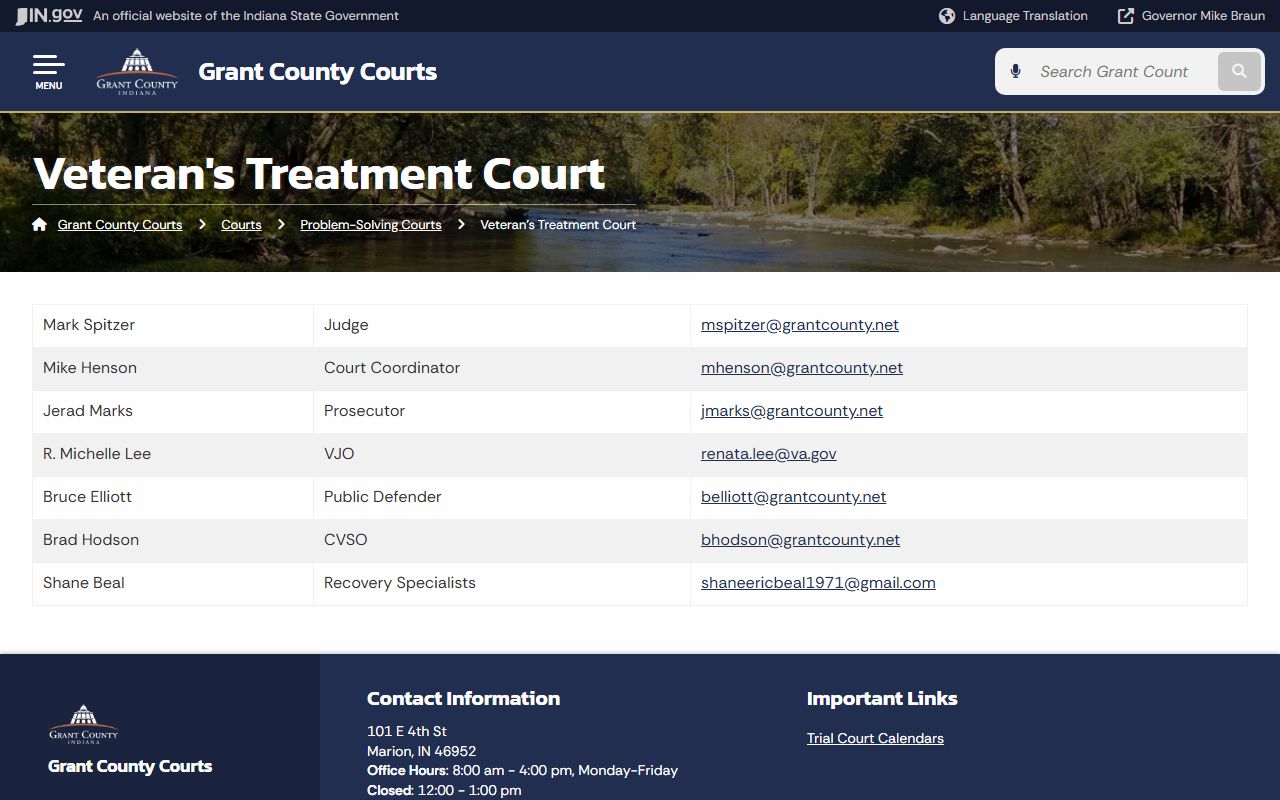
That court source is distinct from probate, but it reinforces why Grant County record users must pay attention to court assignment, program type, and access limits.